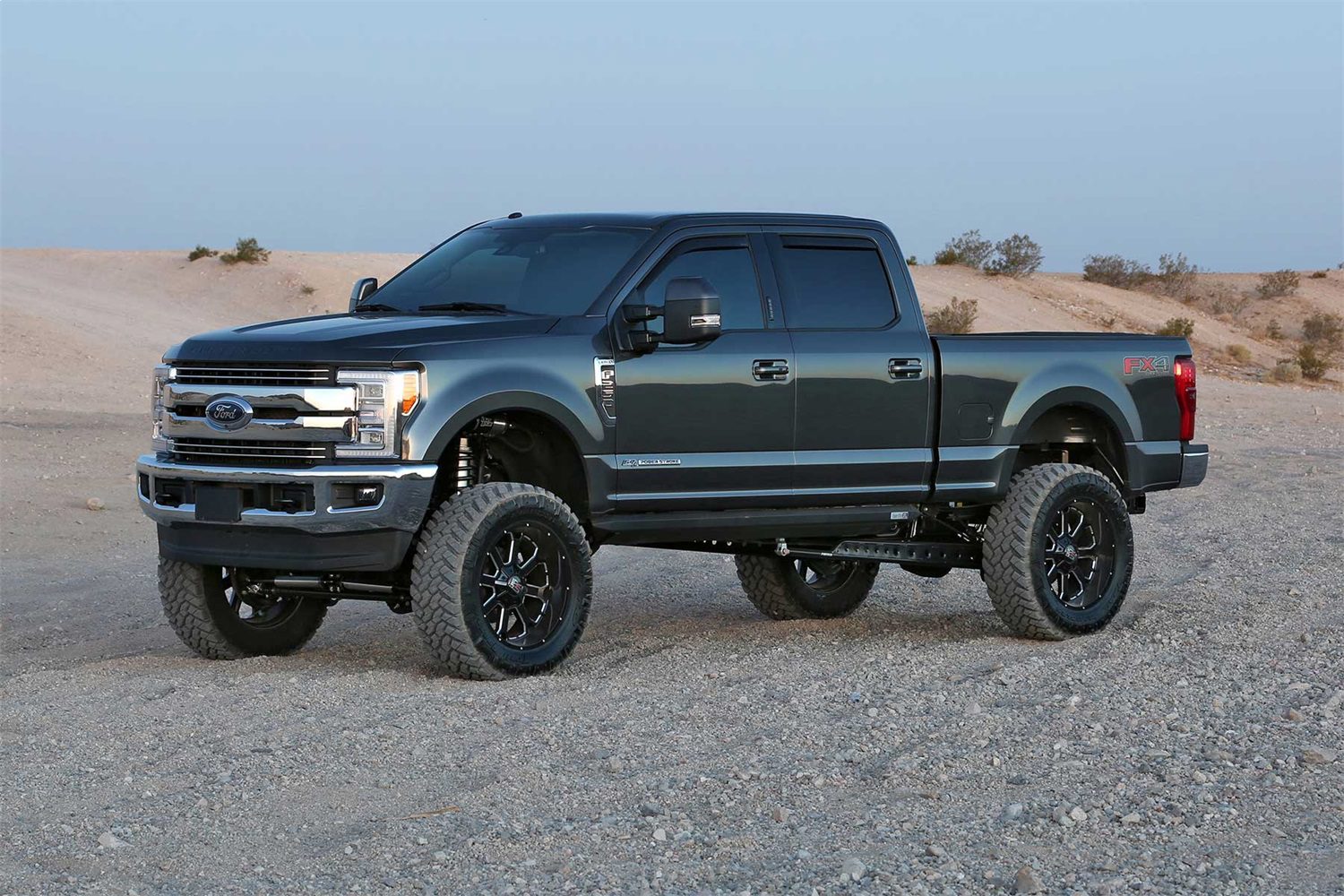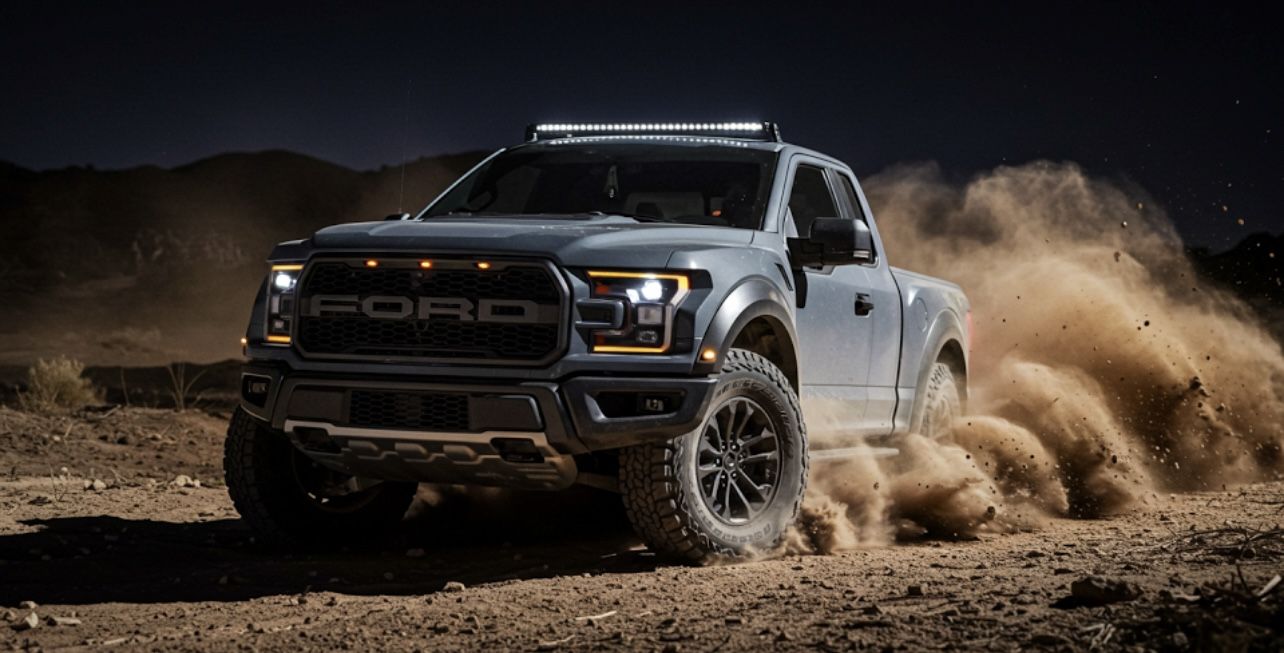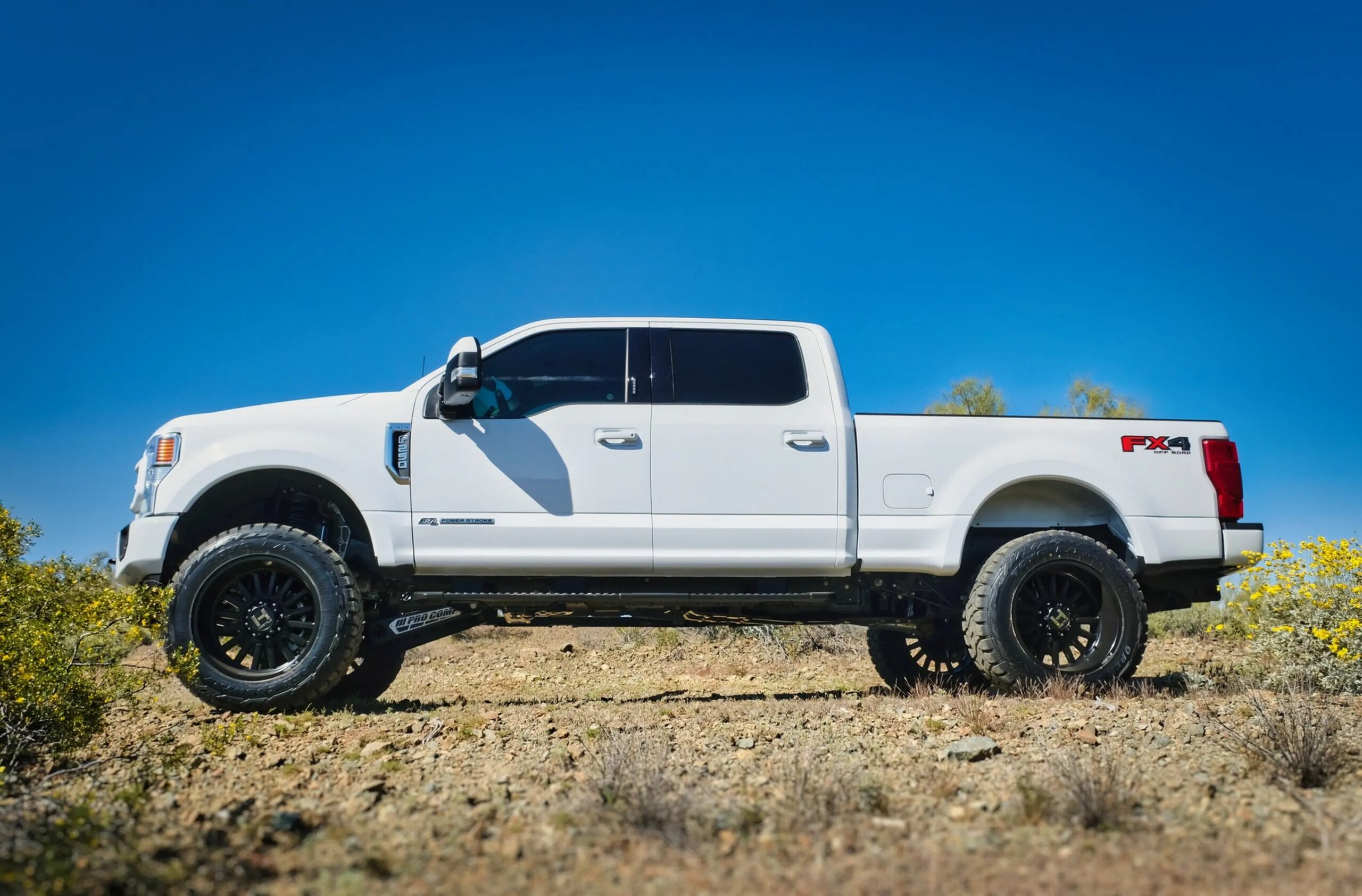
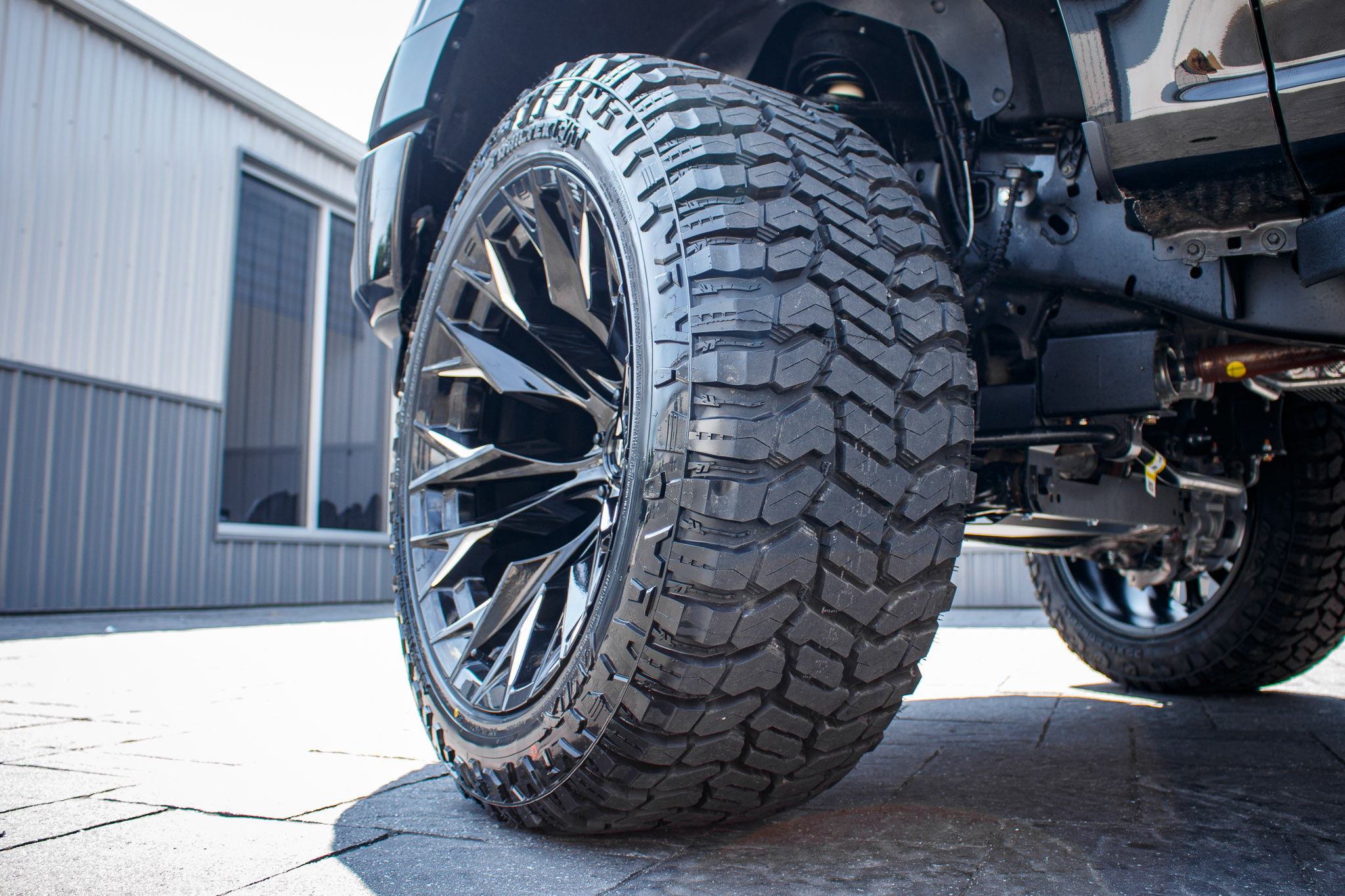
Here’s a hard truth about building trucks: the lift kit gets all the attention, but the wheels and tires for your lifted truck are what actually make or break the build. Get the wheel specs wrong and you’ll have rubbing, sketchy handling, and a truck that looks off — even with a top-shelf suspension under it.
We spec wheel and tire packages every day at the shop. This is the stuff we wish every customer knew before walking in — it’ll save you money, headaches, and the dreaded “it rubs when I turn” conversation.
Start With the Tire Size, Not the Wheel
Most guys shop backwards: they fall in love with a wheel, then try to make a tire work around it. Flip it. Decide your tire diameter first, because that’s what your lift actually clears:
- Leveling kit (2–2.5″): usually clears 33s on most full-size trucks
- 3–4″ lift: typically 34s to 35s depending on the truck
- 6″ lift: 35s comfortably, 37s with the right wheel specs
These are starting points, not guarantees. Your truck’s year, trim, and drivetrain all matter — and so does the wheel, which is where most people get burned.
Wheel Offset and Backspacing: The Part Everyone Skips
If you take one thing from this article, make it this: offset matters more than diameter. Two trucks with the same lift and the same 35-inch tires can fit completely differently because of the wheels.
Offset is how far the wheel’s mounting surface sits from its centerline. More negative offset pushes the wheel outward — that aggressive, wide stance everyone wants. But push too far and the tire swings into the bumper, fender liner, and body mounts at full lock. Too far inward and you’re grinding on suspension components and frame.
This is why we spec wheels and tires for a lifted truck as one complete package. Lift height, wheel width, offset, backspacing, and tire width all interact. Change one number and the whole equation shifts. Internet fitment charts don’t know your truck’s exact combination — we measure and verify on the actual vehicle.
Tire Width Matters Too
A 35×12.50 and a 35×11.50 are both “35s,” but they take up very different amounts of room. Wider tires need more clearance at the fender and bumper, especially with negative offset wheels. If you’re set on a wide setup, be honest about it up front — it changes which lift height and wheel specs we recommend.
All-Terrain vs Mud-Terrain vs Hybrid
Pick your tread for how you actually drive, not for how the truck looks in the parking lot:
- All-terrain (Toyo Open Country AT, Nitto Ridge Grappler, Falken Wildpeak): the sweet spot for daily drivers. Quiet enough for the highway, capable enough for dirt, sand, and light mud. This is what most of our customers end up happiest with.
- Mud-terrain: maximum off-road bite, maximum road noise, faster wear. Great if you actually wheel the truck. Punishing if you commute 60 miles a day.
- Hybrid tires: split the difference — aggressive looks with more road manners than a full mud-terrain.
We carry the big names — Toyo, Nitto, Falken, Hercules, Pirelli, and more — because we’ve seen how they wear, how they balance, and how they hold up. Cheap no-name tires cost less once and then cost you again in balancing issues, uneven wear, and early replacement.
Don’t Forget Load Rating
If you tow or haul with your truck, check the tire’s load rating before you buy. A lot of aggressive-looking tires in popular lifted-truck sizes are passenger-rated, not built for a loaded trailer. The wrong load rating isn’t just a wear issue — it’s a safety issue. We check this on every package we spec for a truck that works for a living.
TPMS, Balancing, and Alignment
The unsexy stuff that separates a professional install from a parking-lot special:
- TPMS sensors get transferred or replaced and programmed — no dash lights when you leave.
- Road-force balancing on big wheel and tire combos, done in-house, so 35s and 37s ride smooth at highway speed.
- Full alignment after everything’s on — because a $3,000 wheel and tire package deserves to wear evenly.
The Biggest Mistakes We See
After years of fixing other people’s setups, the greatest hits are:
- Buying wheels and tires separately from the lift. Then discovering they don’t play nice together. Package it from the start.
- Chasing the most negative offset possible. Stance is great until your tires eat your fenders. There’s a sweet spot — we’ll find it.
- Ignoring the spare. If you’re running 35s, your factory donut isn’t getting you home. Plan for a full-size spare.
- Skipping the alignment. New geometry plus new rubber equals uneven wear within a few thousand miles.
- Buying the cheapest tires available. On a lifted truck, tires are a safety component. Treat them like one.
Wheels and Tires for a Lifted Truck: The Bottom Line
The right setup is a system — lift height, wheel width, offset, tire diameter, tire width, and load rating, all spec’d together for your truck and how you drive it. That’s how you get the stance without the rub, the look without the headaches.
Bring us the vision. We’ll handle the math.
Frequently Asked Questions
Can I fit 35s with just a leveling kit?
Sometimes, on some trucks, with the right (usually conservative) wheel specs. But it’s tight, and “fits” isn’t the same as “fits without rubbing at full lock.” If 35s are the goal, talk to us before buying anything — a 3-inch lift with the right wheels is usually the happier path.
What does negative offset do?
It pushes the wheels outward for a wider, more aggressive stance. A little negative offset looks great; too much causes rubbing and puts extra stress on wheel bearings. There’s a right amount for every setup.
Do bigger tires affect my speedometer and gearing?
Yes. Taller tires throw off your speedometer and effectively raise your gearing, which can dull acceleration — especially with 37s. We can talk through recalibration and whether regearing makes sense for your build.
How often should I rotate tires on a lifted truck?
Every 5,000 to 6,000 miles, without fail. Big, aggressive tires wear unevenly if neglected, and rotation is cheap insurance for a $2,000+ set of rubber.
Get Your Setup Spec’d Right
Stop guessing on fitment. Bring your truck to the shop, tell us the look you’re after, and we’ll spec the complete wheel and tire package — lift, wheels, tires, alignment, all of it — built to fit right and drive right.
Bad Boy Customs
6732 US-19, New Port Richey, FL
727-838-8016
Wheels & tires services · Financing options · Request a quote
We don’t follow trends. We build them. Bad Boy’s got your back.